Tuesday, November 27, 2012

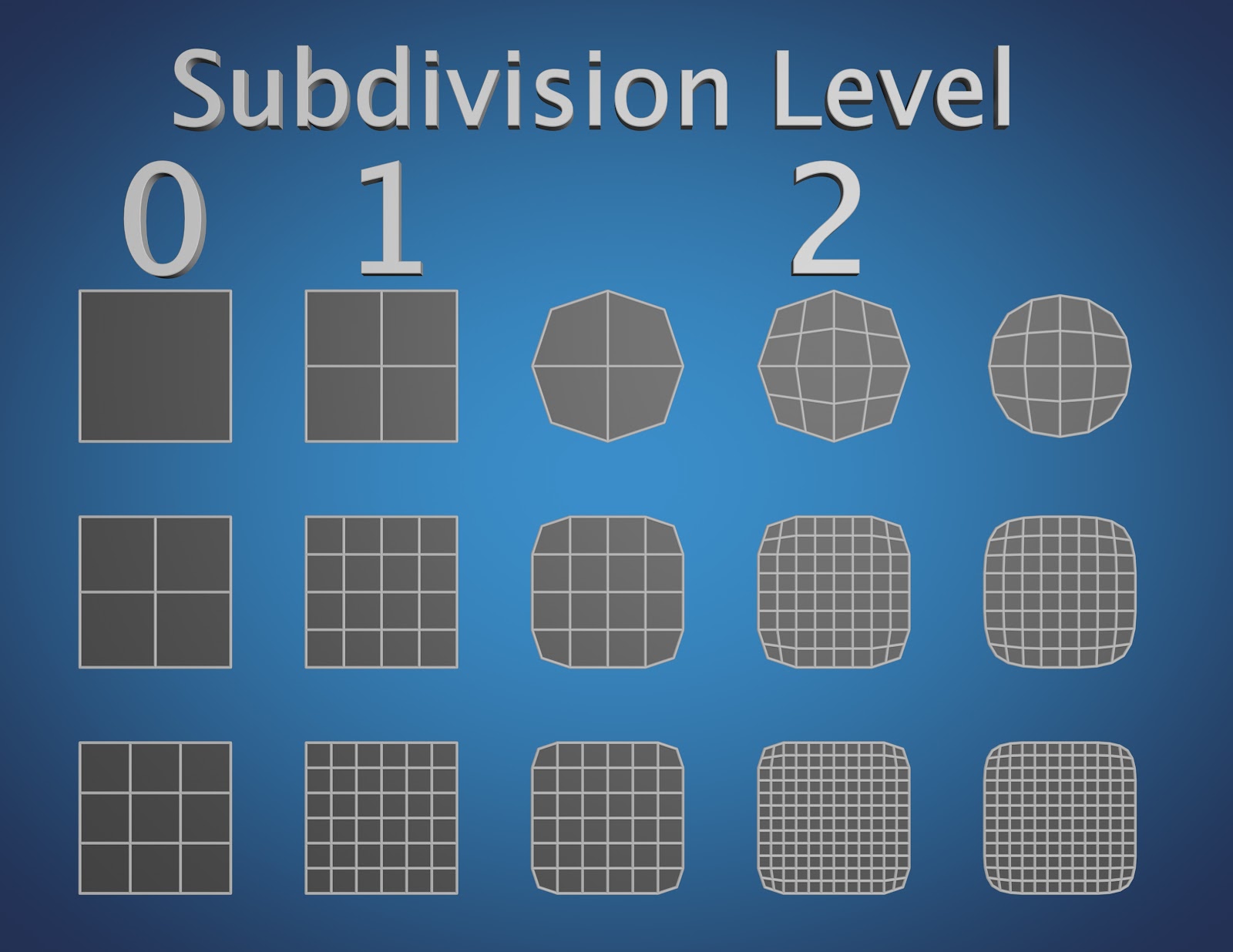
How Do Subdivision Surfaces Work?

This is an article I hope to write at some point, but for now, here are some pictures at a printable resolution...
Stages of subdivision.

Common methods for (trying to) sharpen corners.


Methods for sharpening edges. Some more successful than others.

New C4D Plugin Programming Blog

Some of the Cinema 4D programmers are now writing a Cinema 4D plugin programming blog in their personal time. It looks  like a great resource for any aspiring (and current) plugin programmers.


C4D Programming is written by Frank Willeke, Yannick Puech, and Francesco Guazzi.

Thanks guys!

Friday, November 2, 2012

How to Make Your Own Puppets

The good times keep on rolling here at Nerding Off. Another flash-from-the-past for you, Jim Henson shows you how to create your very own puppets at home!


How Terry Gilliam Made the Animations for Monty Python

Ever wondered how Terry Gilliam created the hilarious animated interstitials for Monty Python's Flying Circus? Well, wonder no longer:


My takeaways:

  • The primary method is cut-out animation. Not unlike the early days of South Park.
  • He got his images from magazines, historical sources, books, and some elements which were custom shot.
  • Most elements require at least two pieces, one with just the moving element, and one with the moving element seamlessly painted out of the background.
  • Embrace the limitations of the medium: motions should be quick, don't select elements that will force you do do a bunch of complex animation (wheels are better than legs).
  • Photographs lend a dimensionality to what would otherwise be an incredibly flat medium.
  • You can recolor BW photos using felt-tip pens.
  • Use a loop of tape to pin down pieces.
  • Use a piece of glass to flatten out the pieces and minimize shadows. Try to light from directly above using 2 lights. The higher the light the better (to mimimize shadows).
  • Have fun!

Wednesday, October 31, 2012

How to Easily Transcribe Audio

After a bit of research I've discovered that for me, the best free audio transcription software is Express Scribe by NCH Software, you can download it here.

1. Optimize your playback hotkeys
To get the most out of your experience, I recommend the following hotkey settings (Options > System-Wide Hotkeys):

Having the key-commands so close at hand basically eliminates the need for a foot pedal.

2. Slow down the default playback speed
Also, when playing back your audio, set the playback speed to something like 50%:

3. Automate the time-stamping process
If it's important that you be able to time-stamp your audio, add the "Copy Time" command to your list of hotkeys (details here). This will automatically make a copy of the current timestamp, using the key commands I have listed above you would use "Ctrl + Num 0" followed by "Ctrl + V" to paste in the time stamp.

Also, to change the format of the pasted timestamp, I recommend the following settings:


Note, you can't see it, but after the suffix brace is a space " ".

This makes the finished time code looks like this:
[00:01:23.4] He said this.

Notes for the software developer:
My primary niggle with the program is that I can't use the same command for play and stop. If that was possible, I'd recommend "Ctrl+Space" as the hotkey so that your hands never have to leave the home position.

Also, it would be great if the software could combine "Copy Time" and "Paste" into a single command, but for a free software this is already worlds better than trying to transcribe in MS Word. 
Monday, October 29, 2012

Experiment #2: Isometric Cubism

A quick experiment in digital cubism. Can a subject be defined simultaneously from three angles? Does this reveal or obscure form?

Experiment #2: Isometric Photo-Based Cubism from Donovan Keith on Vimeo.

Friday, October 26, 2012

Experiment #01: Cosmos

In an effort to keep up my chops in between projects I've programmed a random design assignment generator. Today's assignment was "Create a design using only circles."

I initially created the following in Illustrator:


Then translated the concept to C4D and eventually After Effects:

Here's the finished animation: